credit risk analysis Archives - Page 2 of 6 - DexLab Analytics | Credit Risk | Market Risk | SAS Python Machine Learning Modeling

Time Series Analysis & Modelling with Python (Part II) – Data Smoothing

dexlab_time_series

Data Smoothing is done to better understand the hidden patterns in the data. In the non- stationary processes, it is very hard to forecast the data as the variance over a period of time changes, therefore data smoothing techniques are used to smooth out the irregular roughness to see a clearer signal.

In this segment we will be discussing two of the most important data smoothing techniques :-

  • Moving average smoothing
  • Exponential smoothing

Moving average smoothing

Moving average is a technique where subsets of original data are created and then average of each subset is taken to smooth out the data and find the value in between each subset which better helps to see the trend over a period of time.

Lets take an example to better understand the problem.

Suppose that we have a data of price observed over a period of time and it is a non-stationary data so that the tend is hard to recognize.

QTR (quarter)Price
110
211
318
414
515
6?


In the above data we don’t know the value of the 6th quarter.

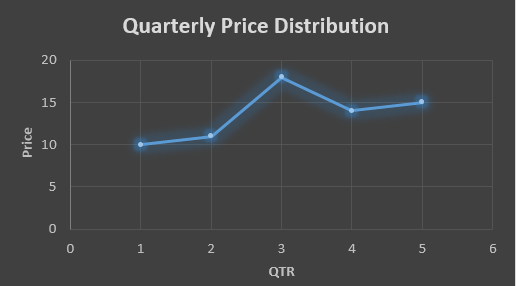
….fig (1)

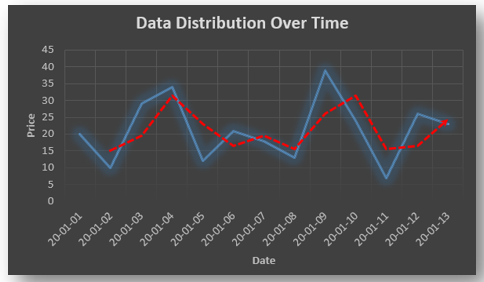
The plot above shows that there is no trend the data is following so to better understand the pattern we calculate the moving average over three quarter at a time so that we get in between values as well as we get the missing value of the 6th quarter.

To find the missing value of 6th quarter we will use previous three quarter’s data i.e.

MAS =  = 15.7

QTR (quarter)Price
110
211
318
414
515
615.7

MAS =  = 13

MAS =  = 14.33

QTR (quarter)PriceMAS (Price)
11010
21111
31818
41413
51514.33
615.715.7


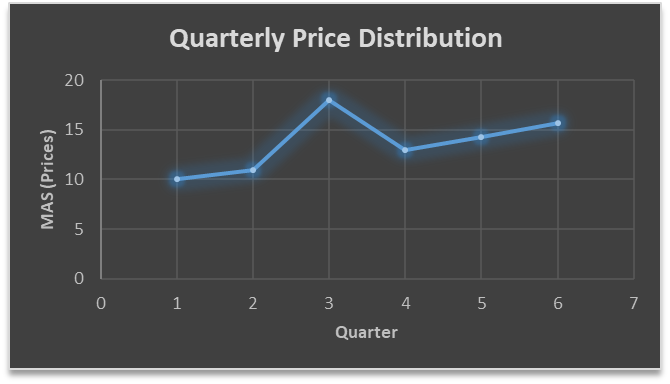
….. fig (2)

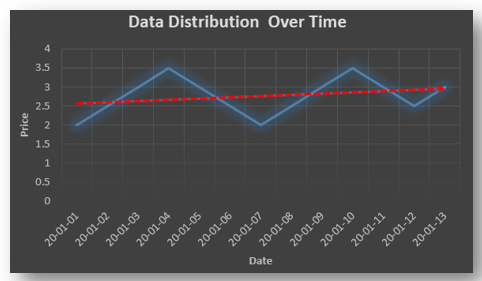
In the above graph we can see that after 3rd quarter there is an upward sloping trend in the data.

Exponential Data Smoothing

In this method a larger weight ( ) which lies between 0 & 1 is given to the most recent observations and as the observation grows more distant the weight decreases exponentially.

The weights are decided on the basis how the data is, in case the data has low movement then we will choose the value of  closer to 0 and in case the data has a lot more randomness then in that case we would like to choose the value of  closer to 1.

EMA= Ft= Ft-1 + (At-1 – Ft-1)

Now lets see a practical example.

For this example we will be taking  = 0.5

Taking the same data……

QTR (quarter)Price

(At)

EMS Price(Ft)
11010
211?
318?
414?
515?
6??


To find the value of yellow cell we need to find out the value of all the blue cells and since we do not have the initial value of F1 we will use the value of A1. Now lets do the calculation:-

F2=10+0.5(10 – 10) = 10

F3=10+0.5(11 – 10) = 10.5

F4=10.5+0.5(18 – 10.5) = 14.25

F5=14.25+0.5(14 – 14.25) = 14.13

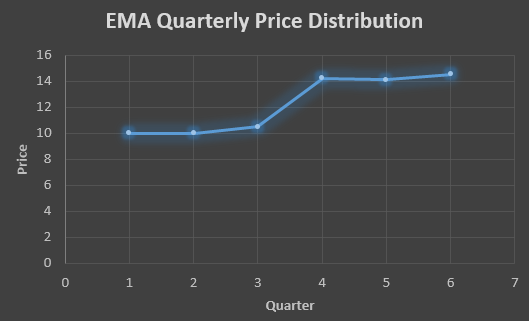
F6=14.13+0.5(15 – 14.13)= 14.56

QTR (quarter)Price

(At)

EMS Price(Ft)
11010
21110
31810.5
41414.25
51514.13
614.5614.56

In the above graph we see that there is a trend now where the data is moving in the upward direction.

So, with that we come to the end of the discussion on the Data smoothing method. Hopefully it helped you understand the topic, for more information you can also watch the video tutorial attached down this blog. The blog is designed and prepared by Niharika Rai, Analytics Consultant, DexLab Analytics DexLab Analytics offers machine learning courses in Gurgaon. To keep on learning more, follow DexLab Analytics blog.


.

Time Series Analysis Part I


A time series is a sequence of numerical data in which each item is associated with a particular instant in time. Many sets of data appear as time series: a monthly sequence of the quantity of goods shipped from a factory, a weekly series of the number of road accidents, daily rainfall amounts, hourly observations made on the yield of a chemical process, and so on. Examples of time series abound in such fields as economics, business, engineering, the natural sciences (especially geophysics and meteorology), and the social sciences.

  • Univariate time series analysis- When we have a single sequence of data observed over time then it is called univariate time series analysis.
  • Multivariate time series analysis – When we have several sets of data for the same sequence of time periods to observe then it is called multivariate time series analysis.

The data used in time series analysis is a random variable (Yt) where t is denoted as time and such a collection of random variables ordered in time is called random or stochastic process.

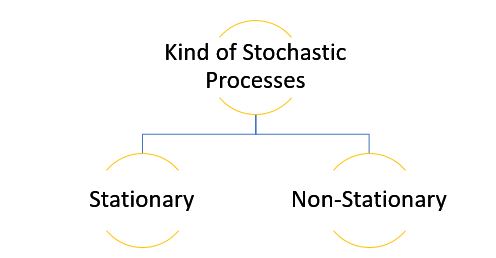
Stationary: A time series is said to be stationary when all the moments of its probability distribution i.e. mean, variance , covariance etc. are invariant over time. It becomes quite easy forecast data in this kind of situation as the hidden patterns are recognizable which make predictions easy.

Non-stationary: A non-stationary time series will have a time varying mean or time varying variance or both, which makes it impossible to generalize the time series over other time periods.

Non stationary processes can further be explained with the help of a term called Random walk models. This term or theory usually is used in stock market which assumes that stock prices are independent of each other over time. Now there are two types of random walks:
Random walk with drift : When the observation that is to be predicted at a time ‘t’ is equal to last period’s value plus a constant or a drift (α) and the residual term (ε). It can be written as
Yt= α + Yt-1 + εt
The equation shows that Yt drifts upwards or downwards depending upon α being positive or negative and the mean and the variance also increases over time.
Random walk without drift: The random walk without a drift model observes that the values to be predicted at time ‘t’ is equal to last past period’s value plus a random shock.
Yt= Yt-1 + εt
Consider that the effect in one unit shock then the process started at some time 0 with a value of Y0
When t=1
Y1= Y0 + ε1
When t=2
Y2= Y1+ ε2= Y0 + ε1+ ε2
In general,
Yt= Y0+∑ εt
In this case as t increases the variance increases indefinitely whereas the mean value of Y is equal to its initial or starting value. Therefore the random walk model without drift is a non-stationary process.

So, with that we come to the end of the discussion on the Time Series. Hopefully it helped you understand time Series, for more information you can also watch the video tutorial attached down this blog. DexLab Analytics offers machine learning courses in delhi. To keep on learning more, follow DexLab Analytics blog.


.

How AI is Reshaping The Finance Industry?

How AI Is Reshaping The Finance Industry?

Technology is bringing about rapid changes in almost every field it touches. Traditional finance tools no longer suit the current tech-friendly generation of investors who are now used to getting information, service at their fingertips. Unless the gap is bridged, it would be hard for firms to retain any clients. Some of the financial firms have already started investing in AI technology to develop a business model that satisfies the changing requirements of the customers and leverages their business.

The adoption of AI has finally enabled the firms to have access to customer-centric information to develop a plan that suits their individual financial goals and offer customer-centric solutions to offer a personalized experience.

AI is impacting the financial industry in more ways than one. Let’s take a look

Mitigating risks

The application of AI has enabled institutes to assess risk factors and mitigate risk. Implementation of AI tools allows the processing of a huge amount of financial records that comprise structured as well as unstructured data to recognize patterns and predict the risk factors. So, while approving a loan, for example, an institute could be better prepared as it would be able to identify those customers who are likely to default and having personnel with a background in credit risk management courses can certainly be of immense help here.

Detecting fraud

One of the most niggling issues faced by the banking institutes is a fraud, and with AI application being available fraud identification gets easier. When any such case happens it becomes almost impossible for institutes to recover the money. Along with that the banks especially also have to deal with false positives cases that can harm their business. Credit card fraud cases also have become rampant and give customers and banks sleepless nights. AI technology could be a great weapon in fighting and preventing such cases. By analyzing data regarding the transaction of a customer, his behavior, spending habits, past cases if any, an oddity could be easily spotted and an alarm could be sent to monitor the situation and take measures accordingly.

Trading gets easier

Investment always comes with a set of risks, the changing market scenario could certainly put your money in a volatile situation. However, with AI in place, the large datasets could be easily handled, and detecting market situations can help to make investors aware of the trends and they can change their investment decision accordingly. Faster data processing leads to quick decision making and coupled with an accurate prediction of the market situation, trading gets smarter as an investor can buy or, sell stock as per stock trends and stay risk-free.

Personalized banking experience

The integration of AI can offer customers a personalized financial experience. The chatbots are there to help the customers manage their affairs without needing any intervention. Be it checking balance or, scheduling payments everything is streamlined. In addition to this, the customers now have access to apps that help keep their financial transactions in check, track their investments, and plan finances without any hassle. There have been a dynamic progress in the field of NLP and the chatbots being developed now are getting smarter than ever and pursuing a natural language processing course in gurgaon, could lead to lucrative job opportunities.

 Process Automation

Every financial institution needs to run operations with maximum efficiency while adopting cost-cutting measures. The adoption of RPA has significantly changed the way these institutes function. Manual tasks which require time and labor could easily be automated and there would be fewer chances of error. Be it data verification or, report generation every single task could be well taken care of.

Data Science Machine Learning Certification

Examples of AI implementation in finance

  • Zest Automated Machine Learning (ZAML) is a platform that offers underwriting solutions. Borrowers with little or, no past credit history could be assessed.
  • Kensho combines the power of NLP and cloud computing to offer analytical solutions
  • Ayasdi provides anti-money laundering (AML) detection solutions to financial institutes
  • Abe AI is a virtual assistant that helps users with budgeting and saving while allowing them to track spending.
  • Darktrace offers cyber security solutions to financial firms

The powerful ways AI is helping the financial institutes excel in their field indicate a promising future ahead. However, the integration is slowly taking place, and still, there is some uncertainty regarding the technology. With proper training from an analytics lab could help bridge the knowledge gap and thus ensure full integration of this dynamic technology.


.

The Growing Significance of AI in Credit Risk Management

The Growing Significance of AI in Credit Risk Management

With more and more sectors turning to AI to find real-time solutions, it is no wonder that AI would gain momentum in the field of credit risk management as well. AI adds efficiency to the process by offering an insight into the portfolios of potential borrowers, which was not available to financial firms up until now. This trend is pushing corporate houses to sign up for credit risk analytics training.

Let’s have a look at credit risk management and figure out how AI can play a key role in building the perfect model.

What is credit risk management

Banks and financial firms lend money to individuals as well as businesses, now credit risk refers to the uncertainty arising due to that borrower, delaying or failing to pay the amount borrowed along with interest resulting in the bank losing money. Remember that infamous recession of 2008?

Credit risk management is about mitigating the risk factor in the process. It involves identifying, analyzing, and measuring the risk factors to keep the risk at a minimal level, or, eliminating the risk if possible.

How AI features in credit risk management

In order to eliminate risk, the bank needs to identify the risk factors, which means going through data, mainly regarding the borrower’s financial activities, portfolio to decide whether that particular individual or, a commercial firm would be able to pay the money back before lending can happen.

But, the process needs to be as much error-free as possible, because while analyzing the portfolios any mistake could lead to failure to recognize a potential defaulter, or, might result in rejecting an applicant who could have been a valuable customer in future. Credit Risk Modelling Courses are being developed to train professionals to deal with this highly specialized task.

AI and especially its subset Machine Learning come into this picture, due to the massive amount of structured and unstructured data involved in the process. The traditional methodology applied by financial institutes is not error-free. processing a huge amount of raw data and identifying patterns is a job that is better handled by AI.

The benefits AI bring to the table

Despite financial firms implementing all sorts of solutions available to them, achieving efficiency in credit risk management has remained a challenge for them due to not having access to smart risk assessment tools, fault in the data management procedure. This is primarily the reason why AI is now being incorporated in the process to achieve better results. With Artificial Neural Networks, Random Forest in place, sorting through loan applications and portfolios to process valuable data and finding patterns becomes easier. Undergoing credit risk modelling certification is almost mandatory for any individual looking forward to having a career in this field. Here are the benefits AI has to offer

  • Data quality: When traditional models are employed they fail to deal with the issue of data quality which for any financial institute could be a big problem. But with Machine learning detecting any oddity in the data entry is easy. Another fact is that detecting complex patterns from diverse data sets to analyze risk factors is essential which traditional models are not equipped to perform.
  • Segmentation is better: While analyzing customer portfolios, AI could help in introducing smart segmentation solutions to gain a deep insight into their profiles, thus ensuring efficient risk recognition.
  • Automated process: Usually organizations have to put together a team for dealing with data handling and report generation tasks, but AI can automate the whole process and minimize the chances of human error while allowing the organizations to set people free to deal with other vital work. Automation would also lead to faster loan processing.
  • Intuitive analysis guarantees accuracy: Usually, traditional models are somewhat rigid, due to functioning as per set guidelines. However, with AI the analysis gets intuitive and as it continues to wade through new data sets, it continues to learn and come up with more accurate predictions.

Data Science Machine Learning Certification

Credit risk management will continue to be a key area for financial firms in the future as well, given the present circumstances, the risk factor would only grow. So, it is time for this sector to recognize and embrace the potential of AI in mitigating the risk.


.

DexLab Analytics Rated One of The Best Institutes in India

DexLab Analytics Rated One of The Best Institutes in India

Analytics India Magazine (AIM), one of the foremost journals on big data and AI in India, has rated Dexlab Analytics’ credit risk modelling course one of the best in India and recommended it be taken up to learn the subject in 2020. Dexlab Analytics is on AIM’s list of nine best online courses on the subject.

In an article, the AIM has rated DexLab Analytics as a premier institute offering a robust course in credit risk modelling. Credit risk modelling is “the analysis of the credit risk that helps in understanding the uncertainty that a lender runs before lending money to borrowers”.

The article describes the Dexlab Analytics course as offering learners “an opportunity to understand the measure of central tendency theorem, measures of dispersion, probability theory and probability distribution, sampling techniques, estimation theory, types of statistical tests, linear regression, logistic regression. Besides, you will learn the application of machine learning algorithms such as Decision tree, Random Forest, XGBoost, Support Vector Machine, banking products and processes, uses of the scorecard, scorecard model development, use of scorecard for designing business strategies of a bank, LGD, PD, EAD, and much more.”

The other bodies offering competent courses on the subject on AIM’s list are Udemy, SAS, Redcliffe Training, EDUCBA, Moneyweb CPD HUB, 365 DataScience and DataCamp.

Analytics India Magazine chronicles technological progress in the space of analytics, artificial intelligence, data science & big data by highlighting the innovations, players, and challenges shaping the future of India through promotion and discussion of ideas and thoughts by smart, ardent, action-oriented individuals who want to change the world.

Since 2012, Analytics India Magazine has been dedicated to passionately championing and promoting the analytics ecosystem in India. We have been a pre-eminent source of news, information and analysis for the Indian analytics ecosystem, covering opinions, analysis, and insights on key breakthroughs and future trends in data-driven technologies as well as highlighting how they’re being leveraged for future impact.

Data Science Machine Learning Certification

Dexlab Analytics has been thriving as one of the prominent institutes offering the best selection of courses on Big Data Hadoop, R Programming, Python, Business Analytics, Data Science, Machine Learning, Deep Learning, Data Visualization using Tableau and Excel. Moreover, it aims to achieve Corporate Training Excellence with each training it conducts.

For more information on this, click here – www.prlog.org/12826797-dexlab-analytics-listed-as-one-of-the-best-institutes-in-india.html


.

A Beginner’s Guide to Credit Risk Modelling

A Beginner’s Guide to Credit Risk Modelling

When a lender starts a financial institution with the aim of lending money to entities, he is most strongly fortified against credit risk. He undertakes several measures to lower credit risk and this is called credit risk modelling.

“A good credit risk assessment can prevent avoidable losses for an organization. When a borrower is found to be a debtor, it could dent their creditworthiness. The lender will be skeptical about offering loans for fear of not getting it back,” says a report.

Credit risk assessment is done to gauge whether a borrower can pay back a loan. The credit risk of a consumer is determined by the five Cs – capacity to repay, associated collateral, credit history, capital, and the loan’s conditions.

“If a borrower’s credit risk is high, their loan’s interest rate will be increased. Credit risk shows the likelihood of a lender losing their loaned money to a borrower.”Credit risk highlights a borrower’s ability to honour his contractual agreements and repay loans.


“Conventionally, it deals with the risk every lender must be familiar with, which is losing the principal and interest owed. The aftermath of this is a disturbance to the lender’s cash flow and the possibility of losing more money in a bid to recover the loan.”

Credit Risk Modelling

While there is no pronounced way to determine the credit risk of an individual, credit risk modeling is an instrument that has largely come to be used by financial institutions to accurate measure credit risk.

“Credit risk modeling involves the use of data models to decide on two important issues. The first calculates the possibility of a default on the part of a loan borrower. The second determines how injurious such default will be on the lender’s financial statement.”

Financial Statement Analysis Models

Popular examples of these models include Moody’s RiskCalc and Altman Z-score. “The financial statements obtained from borrowing institutions are analyzed and then used as the basis of these models.”

Default Probability Models

The Merton model is a suitable example of this kind of credit risk modeling. The Merton model is also a structural model. Models like this take into account a company’s capital structure “because it is believed here that if the value of a company falls below a certain threshold, then the company is bound to fail and default on its loans”.

Machine Learning Models

“The influence of machine learning and big data on credit risk modeling has given rise to more scientific and accurate credit risk models. One example of this is the Maximum Expected Utility model.”

The 5Cs of Credit Risk Evaluation

These are quantitative and qualitative methods adopted for the evaluation of a borrower.

  1. Character

“This generally looks into the track record of a borrower to know their reputation in the aspect of loan repayment.”

  1. Capacity

“This takes the income of the borrower into consideration and measures it against their recurring debt. This also delves into the borrower’s debt-to-income (DTI) ratio.”

  1. Capital

The amount of money a borrower is willing to contribute to a potential project can determine if the lender will lend him money.

  1. Collateral

“It gives the lender a win-win situation, in the sense that upon a default, the lender can sell the collateral to recover the loan.”

  1. Conditions

“This takes information such as the amount of principal and interest rate into consideration for a loan application. Another factor that can be considered as conditions is the reason for the loan.”

Data Science Machine Learning Certification

Conclusion

There is no formula anywhere that exposes the borrower who is going to default on loan repayment. However, the proper assessment of credit risk can go a long way in reducing the impact of a loss on a lender. For more on this, do visit the DexLab Analytics website today. DexLab Analtyics is a premiere institute that provides credit risk analysis courses online.


.

8 Applications of AI and Machine Learning in our Daily Lives

8 Applications of AI and Machine Learning in our Daily Lives

Artificial intelligence (AI) and machine learning are today thought to be one of the biggest innovations since the microchip. With the advancement of the science of neural networks, scientists are making extraordinary breakthroughs in machine learning through what is termed as deep learning. These sciences are making life easier and more streamlined for us in more ways than one. Here are a few examples.

1. Smart Gaming


Artificial Intelligence and Machine Learning are used in smart gaming techniques, especially in games that primarily require the use of mental abilities like chess. Google DeepMind’s AlphaGo learnt to play chess, and defeat champions like Lee Sedol (in 2016) by not only studying the moves of masters but by learning how to play the game by practising against itself innumerable times.

2. Automated Transportation

When we fly in an airplane, we experience automated transportation in the sense that a human pilot is only flying the plane for a couple of minutes during take-off and landing. The rest of the flight is maneuvered by a Flight Management System, a synchronization of GPS, motion sensors and computer systems that track flight position. Google Maps has already revolutionized local transport by studying coordinates from smart phones to determine how fast or slow a vehicle is moving and therefore how much traffic there is on a given road at any point of time.

3. Dangerous Jobs

AI technology powered robots are taking over dangerous jobs like bomb disposal and welding. In bomb disposal, today, robots need to be controlled by humans. But scientists believe there will soon come a time when these tasks would be completed by robots themselves. This technology has already saved hundreds of lives. In the field of welding, a hazardous job which entails working in high levels of noise and heat in a toxic environment, robots are helping weld with greater accuracy.

Data Science Machine Learning Certification

4. Environmental Protection

Machine Learning and artificial intelligence run on big data, large caches of data and mind boggling statistics generated by computer systems. When put to use in the field of environmental protection, these technologies could be used to extract actionable solutions to untenable problems like environmental degradation. For instance, “IBM’s Green Horizon Project studies and analyzes environmental data from thousands of sensors and sources to produce accurate, evolving weather and pollution forecasts.”

5. Robots as Friends

A company in Japan has invented what it calls a robot companion named Pepper who can understand and feel emotions and empathy. Introduced in 2014, Pepper went on sale in 2015 and all the 1000 units were sold off immediately. “The robot was programmed to read human emotions, develop its own, and help its human friends stay happy,” a report says. Robots could also assist the aged in becoming independent and take care of themselves, says a computer scientist at Washington State University.

6. Health Care

Hospitals across the world are mulling over the adoption of AI and ML to treat patients so there are reduced instances of hospital related accidents and spread of diseases like sepsis. AI’s predictive models are helping in the fight against genetic diseases and heart ailments. Also, Deep Learning models which “quickly provide real-time insights and…are helping healthcare professionals diagnose patients faster and more accurately, develop innovative new drugs and treatments, reduce medical and diagnostic errors, predict adverse reactions, and lower the costs of healthcare for providers and patients.”

7. Digital Media

Machine learning has revolutionized the entertainment industry and technology has already found buyers in streaming services such as Netflix, Amazon Prime, Spotify, and Google Play. “ML algorithms are…making use of the almost endless stream of data about consumers’ viewing habits, helping streaming services offer more useful recommendations.”

These technologies will assist with the production of media too. NLP (Natural Language Processing) algorithms help write and compose trending news stories, thus cutting on production time. Moreover, a new MIT-developed AI model named Shelley “helps users write horror stories through deep learning algorithms and a bank of user-generated fiction.”

8. Home Security and Smart Stores

AI-integrated cameras and alarm systems are taking the home security world by storm. The cutting-edge systems “use facial recognition software and machine learning to build a catalog of your home’s frequent visitors, allowing these systems to detect uninvited guests in an instant.” Brick and Mortar stores are likely to adopt facial recognition for payments by shoppers. Biometric capabilities are largely being adopted to enhance the shopping experience.

Key Takeaway

AI is no longer the domain of fiction. It’s our new reality and is it no surprise then that it is revolutionizing our lives. Deep learning training institutes and Machine Learning courses in India along with Artificial Intelligence courses in Delhi abound because India too is attempting to make the most of the AI revolution.


.

Credit Risk Modeling: A Comprehensive Guide

Credit Risk Modeling: A Comprehensive Guide

Credit Risk Modeling is the analysis of the credit risk of a borrower. It helps in understanding the risk, which a lender may face when he offers a credit.

What is Credit Risk?

Credit risk is the risk involved in any kind of loan. In other words, it is the risk that a lender runs when he lends a sum to somebody. It is thus, the risk of not getting back the principal sum or the interests of it on time.
Suppose, a person is lending a sum to his friend, then the credit risk models will help him to assess the probability of timely payments and estimate the total loss in case of defaulters.


Credit Risk Modelling and its Importance

In the fast-paced world of now, a loss cannot be afforded at any cost. Here’s where the Credit Risk Modeling steps in. It primarily benefits the lenders by accurate approximation of the credit risk of a borrower and thereby, cutting the losses short.

Credit Risk Modelling is extensively used by financial institutions around the world to estimate the credit risk of potential borrowers. It helps them in calculating the interest rates of the loans and also deciding on whether they would grant a particular loan or not.

The Changing Models for the Analysis of Credit Risks

With the rapid progress of technology, the traditional models of credit risks are giving way to newer models using R and Python. Moreover, credit risk modeling using the state-of-the-art tools of analytics and Big Data are gaining huge popularity.

Along with the changing technology, the advancing economies and the successive emergence of a range of credit risks have also transformed the credit risk models of the past.

What Affects Credit Risk Modeling?

A lender runs a varying range of risks from disruption of cash flows to a hike in the collection costs, from the loss of interest/interests to losing the whole sum altogether. Thus, Credit Risk Modelling is paramount in importance at this age we are living. Therefore, the process of assessing credit risk should be as exact as feasible.

However, in this process, there are 3 main factors that regulate the risk of the credit of the borrowers. Here they are:

  1. The Probability of Default (PD) – This refers to the possibility of a borrower defaulting a loan and is thus, a significant factor to be considered when modeling credit risks. For the individuals, the PD score is modeled on the debt-income ratio and existing credit score. This score helps in figuring out the interest rates and the amount of down payment.
  2. Loss Given Default (LGD) – The Loss Given Default or LGD is the estimation of the total loss that the lender would incur in case the debt remains unpaid. This is also a critical parameter that you should weigh before lending a sum. For instance, if two different borrowers are borrowing two different sums, the credit risk profiles of the borrower with a large sum would vary greatly to the other, who is borrowing a much smaller sum of money, even though their credit score and debt-income ratio match exactly with each other.
  3. Exposure at Default (EAD) – EAD helps in calculating the total exposure that a lender is subjected to at any given point in time. This is also a significant factor exposing the risk appetite of the lender, which considerably affects the credit risk.

Data Science Machine Learning Certification

Endnotes

Though credit risk assessment seems like a tough job to assume the repayment of a particular loan and its defaulters, it is a peerless method which will give you an idea of the losses that you might incur in case of delayed payments or defaulters.


.

How Machine Learning Technology is Enhancing Credit Risk Modeling

How Machine Learning Technology is Enhancing Credit Risk Modeling

Risk is an intrinsic part of the money lending system. There’s always the chance that customers borrowing money from financial institutions fail to repay their loans. And to determine the exact probability of a customer paying off a loan or defaulting on it, banks and other lenders rely on credit risk modeling.

Next-Gen Credit Assessment Techniques

The credit situation has changed a lot from how it used to be ten years ago. And to keep up, lenders must also evolve by identifying and responding to issues in real-time.  Credit risk strategy has become more complex and multiple factors need to be weighed to arrive at the correct decision that’s both profitable for the enterprise and customer. Sophisticated models that contain more than one dimension, such as additional information about a customer’s finance and behavior patterns, are in demand. These models help get a 360 degree view of the customer’s financial condition.

Moreover, banks want to provide broader financial inclusion with the intention that more customers get credit scores and avail their financial services. But they need to keep a check on their risk levels too. Traditional credit assessment techniques having linear nature, for example logistic regression, are useful, but only till a point.

Neural Networks

Recent developments in neural networks have greatly improved credit risk modeling and seem to provide a solution to the above mentioned problem. One such breakthrough is the NeuroDecision Technology from Equifax that facilitates more inclusive models, so scores and consent can be given to a bigger and varied group of customers.

Machine Learning (ML) is a fast-moving field and neural networks are used within deep learning, which is an advanced form of ML. It has the potential to make more accurate predictions and go beyond the linear analysis methods of logistic regression.  This is a positive development for both the business and its customers.

Linear Vs. Inclusive

What happens in a logistic regression model is that all customers above a straight line (prime) get approved, whereas everyone falling below that line (subprime) gets rejected. Hence, customers who are working hard towards creating a good credit profile but fall just below prime get declined repeatedly. Despite this problem, traditional linear models are widely used because outcomes can be easily conveyed to customers, which helps to be in sync with consumer credit regulations that demand higher transparency.

On the other hand, neural networks lead to non-linear or curved arcs that include those customers who aren’t yet prime, but are evidently moving in the right direction. This increases the ‘approved customer’ base, which is beneficial for the business because customers are being served better and the enterprise is growing. This model is advantageous from the perspective of customers also as it allows more people to access mainstream financial services.  The only problem is explaining the outcome to customers as neural networks tend to be rather complex.

Data Science Machine Learning Certification

Concluding Note

Many companies are producing robust credit modeling tools employing deep learning techniques. And these game-changing developments highlight the fact that they are just the starting point of a series of interesting developments ahead.

You can be a part of this exciting and booming field too! Just enroll for credit risk modeling certification at DexLab Analytics. Detailed courses chalked out and taught by industry professionals ensure that you get the best credit risk training in Delhi.


.

Call us to know more